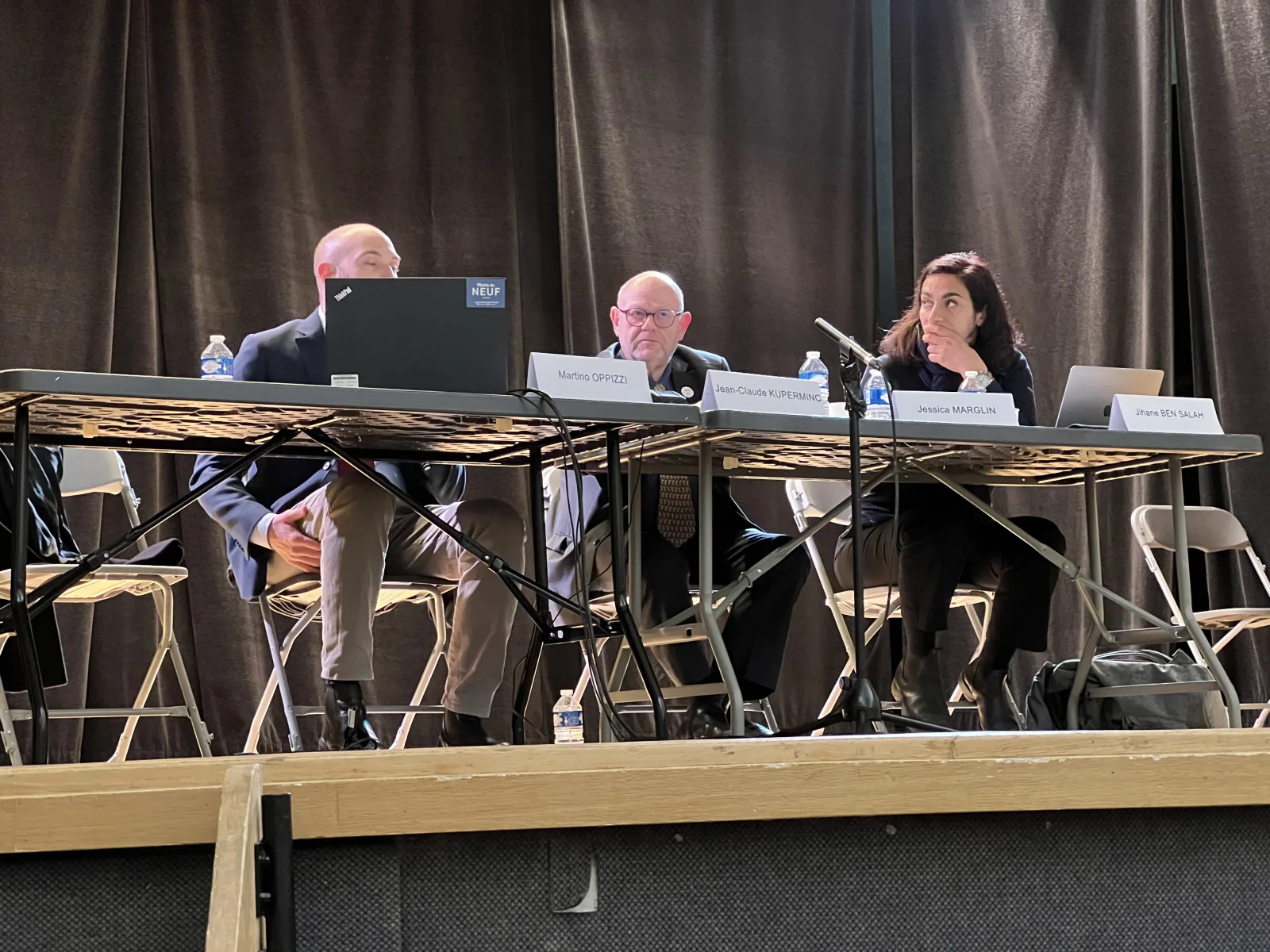
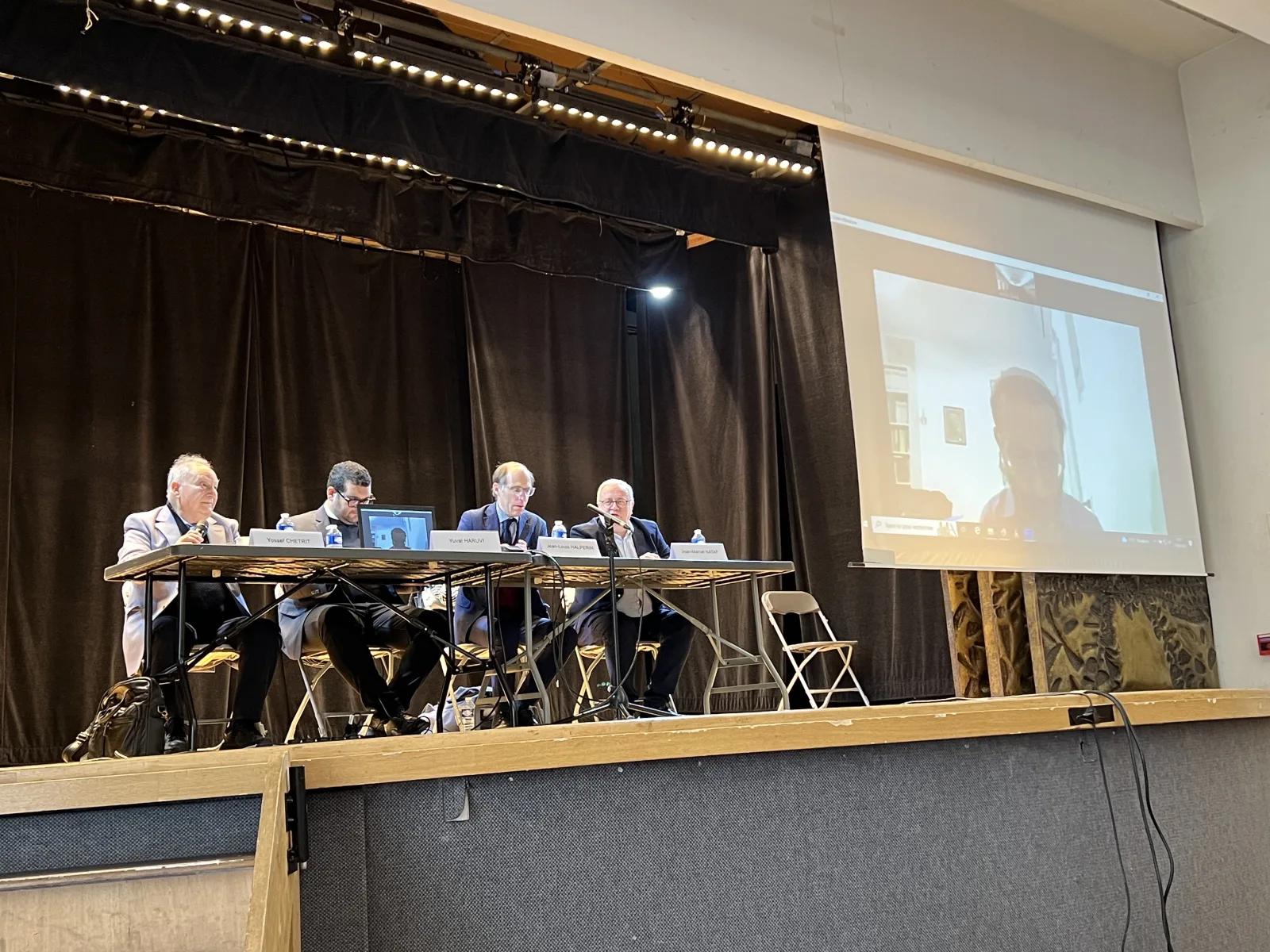
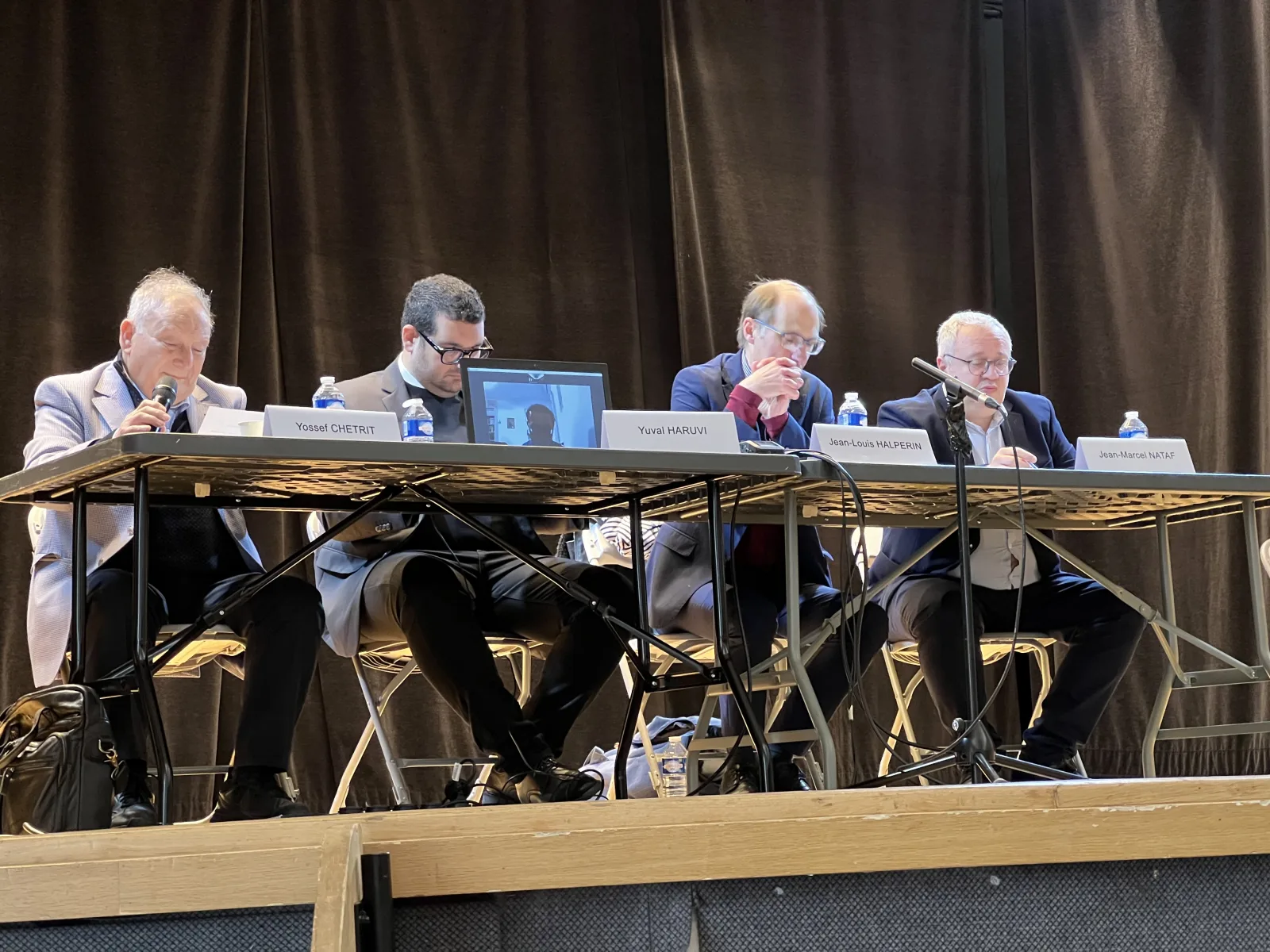
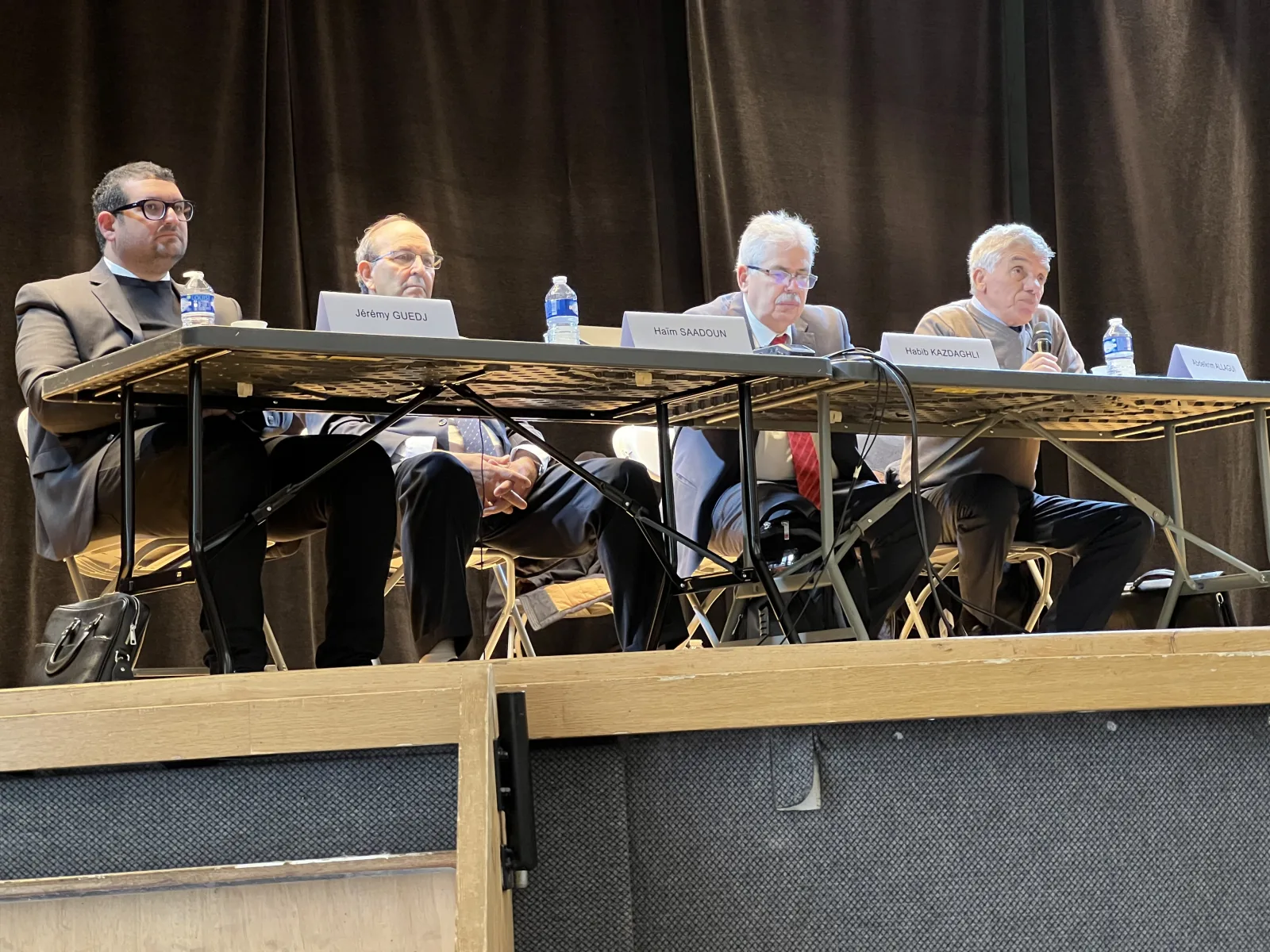
The international conference organised by the Society for the History of the Jews of Tunisia (SHJT) in collaboration with the Centre français du judaïsme tunisien (Paris), entitled “Jews and the law in Tunisia – From the protectorate to independence (1881-1956): between historical progress and religious resilience” was held from 16 to 18 April 2023 in Paris, on the premises of the Mairie du 9ème arrondissement, 6 rue Drouot.
The Groupe Sociétés, Religions, Laïcités of the École Pratique des Hautes Études (UMR 8582 CNRS), the Centre de la Méditerranée Moderne et Contemporaine of the Université Côte d’Azur, the Centre de Théorie et Analyse du droit of the Université Paris-Nanterre (UMR 7024 CNRS) and the library of the Alliance israélite universelle (AIU) were associated with this conference as partners.
Despite the pressure and threats directed at several Tunisian academics who were due to take part in the conference, it was held in excellent conditions before a large audience, including specialists in the history of the Maghreb and students, in particular from Sciences-Po and INALCO, several of whom were themselves from the Maghreb.
Twenty-three researchers and academics from different geographical backgrounds – France, Israel, Tunisia, Italy and the United States of America – took part and presented papers.
The first day (Sunday 16 April 2023), known as the “Young Researchers' Day” and integrated into the conference, was devoted to the presentation of recent work on the history of the Jews of Tunisia or containing elements likely to relate to it. The purpose of this day, organised at regular intervals by the SHJT since 2003, is to enable master’s and doctoral students to present the main outlines or a particular aspect of their research, and to gather information and advice where appropriate. It allows researchers interested in the history of the Jews of Tunisia to take stock of ongoing research. Alongside the students, established researchers are also invited, where relevant, to present their recent publications (books or articles).
Ten speakers followed one another during the day (two Tunisian doctoral students having been prevented from attending by the turmoil that arose in Tunisia around the conference); among these speakers, on account of their recent work, were Mr Antoine Perrier, professor at Sciences-Po Paris and author of a thesis on Tunisian dignitaries and ministers at the beginning of the Protectorate, and Mr Jean-Denis Bonan, director of a film on the ruins of Carthage with a focus on the Jewish presence in Roman Carthage.
The day was divided into three sessions, one in the morning and two in the afternoon, chaired in turn by Joëlle Allouche-Benayoun, Senior Lecturer and associate researcher at the École pratique des Hautes Études, Mireille Hadas-Lebel, professor emeritus at the Sorbonne, and Valérie Assan, president of the French commission for Jewish archives.
The first session brought together work on art and literature, the second work on political questions, and the third work on individual figures or groups.
Overall, all the papers were of good quality, some revealing remarkable work, such as that of Marie-Anne Guez on the Jews of Tunisia during the two World Wars, others work that is still at an early stage but promising. There was no poor-quality paper.
The open discussions with the audience after each session provided the speakers with information or advice on finding sources or on the methodology to follow in their work.
While we welcome the quality of the papers heard, we must nevertheless note the decline in the number of doctoral students interested in the subject, not only in France but also in Tunisia and Israel. Several reasons may explain this, including the fall in the number of doctoral candidates and the difficulty of access to sources located in Tunisia for Israeli researchers, and to those located in Israel for Tunisian researchers.
The contacts made on the occasion of this day will give rise to exchanges of information and sources. They have also enabled young doctoral students to benefit from advice and new points of support. In this sense the day was a success and an initiative that is appreciated and should be continued.
The theme of the conference was addressed on Monday 17 April and Tuesday 18 April. Seeking to combine history and law in order to fully appreciate the condition of individuals, the members of the scientific steering committee called on the respective expertise of historians and legal specialists, notably in legal history. In terms of time frame, the conference was not limited to the colonial period but also examined the conditions under which the legal status of the Jews was modified in the early days of independence.
The papers were divided into five sessions, including the one devoted to the synthesis: three on Monday 17 April and two on Tuesday 18 April.
During the first session, the legal and religious status of the Jews of Tunisia was examined through the press, journals and writings. This showed that before the establishment of the Protectorate, the condition of the Jews of Tunisia was subject to the arbitrariness of beylical power and of a partial justice that judged according to the rules of Islam. Inspired by the ideals of 1789 and what they had brought to the Israelites (in general), the Jews of Tunisia were naturally inclined to opt for France, all the more so once France placed Tunisia under its Protectorate.
But by enshrining legal pluralism – that is, the existence and application, on the same territory, of different legal systems to different populations – the Protectorate did not allow all their aspirations to legal emancipation to be fulfilled. Thus, for several decades, the Protectorate did not open the way to a change of nationality and legal assimilation: their personal status and inheritance continued to be governed by Mosaic law, scrupulously applied by the rabbis who made up the Rabbinical Court. As a result, the French courts, which had jurisdiction in all civil and commercial cases involving Europeans or protected persons, were obliged to refer to the rabbinical jurisdiction (whose judges were appointed by the Tunisian government) the settlement of Israelites’ cases relating to their personal status and inheritance. More broadly, since not all inequalities between Jews and Muslims had been abolished, their property status remained dominated by Koranic law. Moreover, their situation remained inferior to that of the Europeans settled in the Regency, who enjoyed the privilege of French jurisdiction.
Yet, in order to benefit from fair treatment and the guarantees of modern laws, those Jews who aspired to them had to break the ties that bound them to the Tunisian State and join the protecting nation, whose customs and language they were eager to adopt. This meant opting for French naturalisation.
In reality, the work examined during this session showed that what was at stake through and beyond a conflict of jurisdictions was a shift in civilisational paradigm: breaking away from the Tunisian model, judged backward and unequal, in order to embrace the French philosophical, political and legal ideal, synonymous with the future. This was the position defended with the utmost vigour by the lawyer Jacques Chalom, whose thesis, published in 1905, was the subject of a paper.
The Protectorate did not seem likely to fulfil all the hopes the Jews had placed in it. As a result, their aspiration to come under French laws and French courts was all the more galvanised, to the point of becoming almost irrepressible, for they considered that French laws and French courts alone could give them access to fair and impartial justice. To this end, a substantial proportion of the Jews of Tunisia was therefore prepared to give up their personal and inheritance status, as well as the supremacy of the rabbinical jurisdiction. In order to escape the jurisdiction of both the Tunisian courts and the Rabbinical Court, the elites trained in French universities thus ardently championed the extension of French jurisdiction and French nationality to the Israelites of Tunisia. As for the rabbinical court, the beylical decree of 1898 that reorganised it placed it from then on in the orbit of France and modernity. Previously subject to the control of the Caïd of the Jews, it was henceforth placed under the supervision of non-Jewish representatives of the French government (subordinated for the first time to non-Jewish governmental and judicial authorities, in a system entirely under French control).
In the second session, the conference – notably through a paper by the Israeli academic Yuval Haruvi – revealed the will of part of the Tunisian rabbinate, under the impetus of Rabbi Israël Zitoun, who presided over it for 23 years, to reconcile jurisprudence with the demands of modernity: thus they now showed themselves opposed to penalties considered archaic – the herem (excommunication), corporal punishment – or to bigamous marriages. For Rabbi Zitoun, the modern values prevailing in present-day reality should be regarded as a kind of “fifth part” of the Shulhan Arukh, the spirit that gives life to the other four, those relating to ethical and logical considerations constituting the driving force and the basis of every halakhic decision.
These rabbinical forays towards modernity had been nourished by the Jewish Enlightenment movement, the Haskalah, which sought to combine faith, reason and modernity, and which was examined in the same session through the writings, some of them unpublished, of Rabbi Shalom Flah, one of the paradigmatic figures of this movement,
The third session, aptly entitled “Turning Point and Civilisational Choice”, made it possible to analyse the situation at the time when French naturalisation became possible for a large number of the Jews of Tunisia.
It emerged that the Jews’ enthusiasm for acquiring French nationality between the wars could not be attributed to or explained solely by “sympathy for France”, nor by any particular sympathy of the French administration towards them, but rather by the fact that “both protagonists” gained from it: France, whose interests were thereby better defended and promoted, and the applicants, on whom naturalisation conferred an advantageous status, since it came with numerous rights attached to nationality (access to French courts, social rights, exercise of civic rights, access to public employment, salary and remuneration, ease of travel, protection of nationals).
The demonstration seems all the more pertinent given that French naturalisation of the Jews of Tunisia rose significantly from the Morinaud law of 1923 onwards, whereas until then it had been granted very sparingly. Consequently, behind the universalist promises of the French coloniser, to which this phenomenon might conventionally be attributed, lies a very different and more prosaic reality:
- for France, increasing its influence and defending and promoting its interests by enlarging the French population of the Regency, which at the time represented only 3% of the total population and only 35% of the Europeans, who were mostly Italians – and this in the context of the imperialist ambitions of Fascist Italy.
- for the Jews, who were very clearly over-represented among naturalised Tunisians, the desire to acquire French nationality, explained as much by social reasons as by reasons of status (professional, residential, political, legal). This desire for French naturalisation also affected Italian Jews, well before the introduction of racial laws in Italy.
The fourth session extended into the early days of Tunisian independence. On gaining independence in 1956, Tunisia simultaneously placed itself under the auspices of a modernity understood, very concretely, in its legal sense and, more particularly, of a reformed and unified justice system. It was in this context that the new code of personal status was promulgated on 13 August of the same year; its provisions, initially applicable only to Muslim Tunisians, were extended in 1957 to Jewish Tunisians. Consequences on the Muslim side: abolition of the Sharia court, introduction of principles unknown to Sharia (prohibition of polygamy, etc.) and application of these new provisions by a secular court. Consequences on the Jewish side: abolition of the rabbinical court as an independent jurisdiction. According to its critics (Charles Haddad), however, this reform caused a double rupture: one between Muslims and Jews, whose centuries-old understanding rested on two distinct orders of jurisdiction – the Sharia court for Muslims and the rabbinical court for Jews; the other dividing the Jews among themselves, between opponents of these reforms, which ran head-on into a personal status hitherto governed by Hebrew law and rabbinical courts (alone competent in family law, for all matters relating to marriage, divorce[1], inheritance, etc.), and, on the other hand, unconditional supporters of entry into modernity.
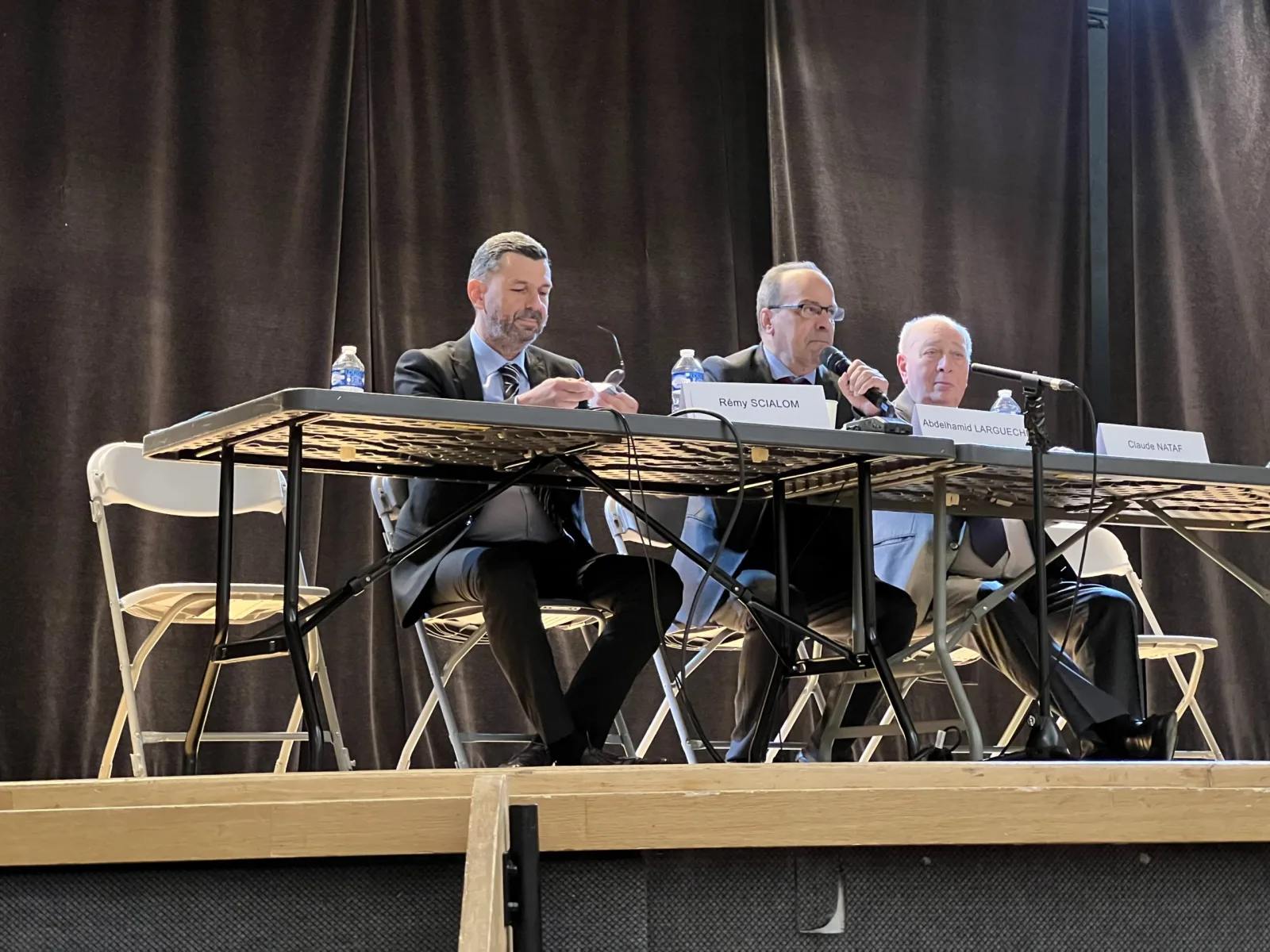
The synthesis of the conference, brilliantly presented by Professor Rémy Scialom, drew together the conclusions of the various papers, highlighting the continuity in the Jews of Tunisia’s desire for a modern and egalitarian justice and their deep attachment to the ideals of the Enlightenment and the principles of 1789, embodied in their minds by France. The synthesis also demonstrated the vitality of research on the history of the Jews of Tunisia and the value of studying this history in the light of legal status and its evolution over time. Many fields thus open up for researchers to explore.
All the papers were delivered in French, and French was also the sole language of the debates. It was emphasised that French is today the language of dialogue between Jews originating from former French North Africa and the Muslims of these countries. Adopted at different paces by the two populations, the French language became a common denominator after the exile of the Jewish populations.
The various sessions of the conference were chaired in turn by Habib Kazdagkli (University of Manouba, Tunisia), Jean-Louis Halpérin (Université Paris-Nanterre), Jean-Claude Kuperminc (curator of the library of the Alliance israélite universelle) and Yossef Chetrit (University of Haifa). The closing session was chaired by Abdelhamid Larguèche, professor emeritus at the University of Manouba, Tunisia.
On the sidelines of the conference, the participants made many contacts and exchanged their views in a strictly scholarly spirit, free of all prejudice and ideology.
Image
Photos