Passing of Albert Memmi – message from the President of the SHJT
I have just been informed of the death of Albert Memmi, which occurred during the night of Thursday to Friday 22 May. A fine pen has stopped writing, a voice has fallen silent, a Master has ceased to teach, a stern and attentive conscience will enlighten us no more.
The emotion that grips me as I must pay tribute to his memory on behalf of the Society for the History of the Jews of Tunisia makes me doubt my ability to write down everything that comes to my mind.
In the first years following Tunisia’s independence, as I was finishing my secondary studies, we were a small group of friends dreaming of literary glory and resting from Tacitus and Xenophon by translating our first stirrings into schoolboy verse. Alain-Gérard Slama, two years our senior, who had been awarded the prize for Latin translation at the Concours général of lycées and collèges, urged us to follow him on the road to the rue d’Ulm, but Albert Memmi showed us that one could be Jewish, born in Tunis, and become a French writer. La Statue de Sel and above all Agar never left us. André Malraux was dusting off the Odéon, where Barrault was staging Tête d’Or; Sartre was publishing Les séquestrés d’Altona, and Camus, the glorious Nobel laureate, had the courage to declare that his mother came before Justice. But heedless of all this agitation, we dreamed over the words of a classmate back from Paris who had caught sight of Albert Memmi in Saint-Germain-des-Prés. We imagined him lunching with Sartre at the Flore, taking tea at the Deux Magots with Simone de Beauvoir, drinking a punch at the Rhumerie Martiniquaise with Albert Camus before going off to kiss the fingers of a few duchesses with the features of Oriane de Guermantes. We all dreamed of being Albert Memmi, and we imagined that he was us. I remember writing one evening of doubt, in the midst of preparing for competitive examinations, in a parody of Victor Hugo: “I want to be Albert Memmi or nothing.”
When, much later in Paris, freed from my illusions, I met Albert Memmi and he did me the honour of receiving me, listening to me, conversing with me and advising me, my admiration was in no way diminished; more reasoned and more considered, it never ceased to grow.
Deeply rooted in our native Tunisia, born into a family nourished by Jewish tradition, a pupil of the French school, later married to a Christian, teaching and living in France, read and translated on every continent, Albert Memmi embodies that cultural plurality which is the hallmark of Tunisia. This variety of experiences, and at times of tribulations, had sharpened his gaze, at once anxious and nuanced, and his constant commitment against fear and the rejection of the other.
He, who had been prefaced by both Sartre and Camus, was in this twenty-first century one of the last representatives of the Republic of Letters, as the eclecticism of his literary admirations and of his relationships attests.
Above all, I would like to emphasise here his loyalty to the history of the Jewish community of Tunisia, into which he was born and which is present in almost all his works.
During the visit that the late Jacques Taieb and I paid him in 1997 to tell him of our plan to create the Society for the History of the Jews of Tunisia in order to foster scientific research and academic exchanges, he did not merely encourage us but gave us constant and kindly support, placing his renown at the service of our brand-new association. Ever since, he never failed to highlight the quality of our work and the exemplary continuity of our research, and he never failed to recall that he was an honorary member of our association and that he had spoken in 1999 and in 2003 at the international conferences we had held at the Sorbonne. On two occasions, in March 2000 and in November 2003, we organised study days on his work, from a perspective more historical than literary, with the participation of Tunisian and Israeli academics.
Last Tuesday, two days before his death, he attended, thanks to the internet and the Zoom application, the lecture given under the auspices of our society by Jean-Marcel Nataf on the masterpieces of the Tunisian rabbis. I had been happily surprised by his presence and his serene features, and to see that his smile, so piercing and so expressive of his personality, appeared on the screen from time to time as he listened attentively to a talk whose theme was not one of his favourite subjects.
In the days and weeks to come, tributes will no doubt multiply and will express better than I do here the greatness of Albert Memmi’s work.
Today I think of the Man, of all that he represented for many, myself among them, and I try to recall the words of our many exchanges.
His work is marked at once by his Jewish identity, by his native Tunisia so dear to his heart, and by French culture, that of the France of the Rights of Man, the France of Michelet and Zola. For historians it will remain the reference for what, for centuries upon centuries, the Jewish presence in Tunisia was.
The great works of the mind enjoy a precious privilege. They live on and endure beyond their authors. The work of Albert Memmi is one of them. In this sense, Albert Memmi will live on.
Claude Nataf
President of the Society for the History of the Jews of Tunisia
25 May 2020
SHJT speakers
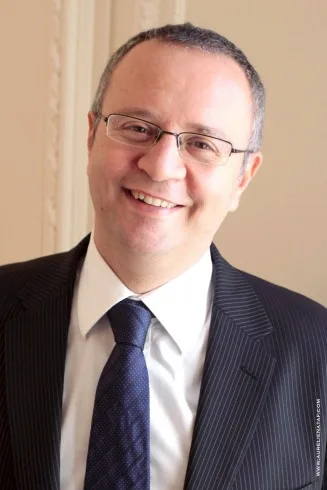
Jean-Marcel Nataf
Vice-President
Biography
Lawyer, President of the French Centre for Tunisian Judaism (https://cfjt.fr) (CFJT), specialising in research into and the dissemination of theological works by Tunisian rabbis; member of the FSJU Executive Committee since 2008; member of the SHJT Board of Directors from 2018 to 2020

Claude Nataf
Founding President
Biography
Top of his class at the Institut d’études politiques de Paris (1967), postgraduate diploma (DEA) in twentieth-century history from the Fondation nationale des sciences politiques, vice-president of the Commission française des archives juives, founding president of the Society for the History of the Jews of Tunisia, departmental delegate of the French national education system
